Posts tagged cultural worlds
 Food stamps and farmers markets
Nate
:

In the 2008 farm bill, Congress allocated $20 million for a pilot program to explore how to create incentives to purchase fruits, vegetables or other healthful foods in order to improve the diets of food stamp recipients and potentially reduce obesity. Several nonprofit groups and foundations are experimenting with similar incentives.
One is the Wholesome Wave Foundation, an organization that works to make locally grown food more widely available. In the spring, it launched a program that doubles the value of food stamps and fruit and vegetable vouchers of low-income mothers and seniors who use them at farmers markets in Connecticut, Massachusetts and California.The Wholesome Wave matching grants were an instant hit at the City Heights market in San Diego. On the first day that matching funds became available, sales using government-issued electronic benefit cards soared by more than 200 percent. In subsequent weeks, the line to receive matching vouchers formed at 7:30 a.m., and the available funds were exhausted by 9:30 a.m., just 30 minutes after the market opened.
“We’re not taking away your benefits because you spend them on Twinkies,” said Michel Nischan, a Connecticut chef and president of Wholesome Wave. “But if you decide you want to spend it on fresh tomatoes, you’ll get double your money.”
Visitors and collectors
Nate
:The experience of purchasing art shares much in common with viewing it in exhibits, according to a new study in the Journal of Consumer Research. Author Yu Chen (Oakland University) shows that visiting a gallery can provide many of the same benefits as buying a painting….
The author found that art collectors and visitors to galleries and museums share many desires and values, including otherness, sociality, philanthropy, spirituality, aesthetics, and novelty. How collectors differ from visitors is in their desire for a long-term intimate relationship with the artworks. Visitors want to avoid repetition and dullness, and like the experience of sharing art communally.
Chen also found that the experiences of both art purchasers and art viewers do not always correspond with their expectations. “This contradiction implies that desire and illusions, more than value and perceptions, are the driving forces behind consumption,” writes Chen.
Adieu, S.U.V.’s
Nate
:Here is the puzzling thing. The apparent cause of death for S.U.V.’s was high gas prices. Doesn’t that mean that with low gas prices S.U.V. sales should come back to life? I can think of a few reasons why that might not be the case:
1) Consumers think that the low current gas prices are temporary, and in general gas prices will be high in the future. Thus, they don’t want to get stuck with a vehicle that gets poor gas mileage. The question this raises is why consumers were so sure six months ago that gas prices were going to be high forever (which turned out to be wrong), but don’t believe now that gas prices will stay low.
2) The uncertainty of fluctuating gas prices takes the fun out of owning an S.U.V. Even if gas prices won’t be that high on average, it is so unpleasant to have an S.U.V. when gas prices are high that people don’t want to have them if gas prices are volatile. This explanation seems kind of dumb to me, but maybe it is possible.
3) When gas prices got high, it became uncool to own an S.U.V. Perhaps the process for going from cool to uncool is not easily reversible. Once something is uncool, it remains uncool for a long time, even when the forces that caused it to be uncool recede. This might explain why the demand for pickup trucks remains strong, even as S.U.V.’s fade. Somehow the spike in gas prices didn’t make pickup trucks uncool in the same way as S.U.V.’s. Similarly, minivans have never been cool (or at least not for a long time); so if this explanation is right, minivan sales should stay strong.


Nate
:
Nate
:Nate
:Barbecuing in my sackcloth.
The turkey is smoking well. The children have gone to bed, but they’ll be up at dawn to open their presents.
The night is clear and cold. There is no moon. The light of the transmitter lies hard by Jupiter, ruby and diamond in the plush velvet sky. Ellen is busy in the kitchen fixing stuffing and sweet potatoes. Somewhere in the swamp a screech owl cries.
I’m dancing around to keep warm, hands in pockets. It is Christmas Day and the Lord is here, a holy night and surely that is all one needs.
On the other hand, I want a drink. Fetching the Early Times from a clump of palmetto, I take six drinks in six minutes. Now I’m dancing and singing old Sinatra songs and the Salve Regina, cutting the fool like David before the ark or like Walter Huston doing a jig when he struck it rich in the Sierra Madre.

Nate
:
Nate
: A time for branding

Nate
: Non-stupid romantic comedies
Nate
:
If you were on the Internet this week you probably heard that love can no longer exist in the age of the romantic comedy. But like all cultural artifacts, while 95% of the output is rubbish, there are some real gems. I love Sliding Doors and Bridget Jones’ Diary isn’t all that bad. Next Stop Wonderland is one of my all-time favorite movies. (NYT captures it perfectly in this 1998 review.) Little Black Book is actually a weird Network-inspired satire and I’d consider Neil LaBute ’s The Shape of Things a rom-com too. To believe the genre is inherently stupid is like dismissing horror because Eli Roth makes movies.
 Greenback, Tennessee
Nate
:Passport census
Nate
:I also admire the State Department’s evident desire to create an Album of America—a collection of snapshots that, over the course of the passport’s twenty-eight pages, catalogues the members of our national family. And I am impressed with the diversity the State Department has achieved. Aside from (i) the distant silhouettes of the passengers and crew of the Mississippi Steamer and the Yankee Clipper, (ii) a shadowy herd of cows, and (iii) the identification photograph of the passport holder, the new passport depicts American life in the following numbers:
| Geese: | 13 |
| Male Humans: | 11 |
| Longhorn Cattle: | 8 or 9 |
| Bald Eagles: | 6 |
| Horses: | 3 |
| Totemic Spirits: | 3 |
| Bison: | 2 |
| Oxen: | 2 |
| Seagulls: | 1 |
| Grizzlies: | 1 |
| Salmon: | 1 |
| Female Humans: | 1 |
Of the eleven men, nine are white. The other two are cowboys whose race is rendered indeterminate by their Stetson hats. The lone woman is the Statue of Liberty.
One hand, one heart, two tongues
Nate
:Added excitement comes from the bilingual reworking of the libretto. When Maria sings I Feel Pretty it comes out as: “Hoy me siento/Tan Hermosa/Tan preciosa que puedo volar/Y no hay diosa, en el mundo, que me va a alcanzar.”
Lin-Manuel Miranda, creator of the recent hit musical In The Heights, which focuses on a poor neighbourhood of Manhattan’s Washington Heights faced with gentrification, was recruited to rewrite the lyrics. The Sharks sing in Spanish, with English surtitles, while the delinquent Jets sing in English.
Laurents was given the idea of a bi-lingual show after his companion, Tom Hatcher, who died two years ago, saw an all-Spanish staging of the musical in Colombia in which the Sharks – the Capulets of Shakespeare’s play – were transformed into heroes, the Jets into villains.
Laurents intends to make the new version darker and more threatening than previous stagings, certainly more so than the film, of which he is disparaging. “I thought the whole thing was terrible. Day-Glo costumes and fake accents!” he told the Washington Post.
AsLOLn

Nate
:LOLCat-tharsis
Nate
:Internet | The meaning of LOLcats, explained by a Psychology Today editor: “Just as the dogs in the New Yorker cartoons don’t represent actual dogs, these cats don’t represent cats at all, but people. By using cats, icanhascheezburger can access themes more tragic and poignant than it could using people.” [Salon]
Nate
: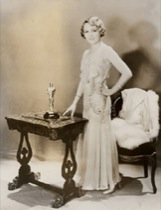
And the Oscar for best Hollywood courtroom drama goes to . . . the Academy of Motion Picture Arts and Sciences. The golden statuette was awarded Monday by a Los Angeles Superior Court jury, which ruled that if Mary Pickford’s heirs want to sell it, they have to offer it to academy officials for $10 instead of auctioning it off for as much as $800,000. Academy leaders took a Rancho Mirage woman, her daughter and a cousin to court after the women announced plans to sell the Oscar presented in 1930 to the silent-movie star known as “America’s sweetheart” and donate the proceeds to charity.
Baby on board
Nate
:
In truth, experts say, the developing world doesn’t need more incubators. It needs incubators that work. Over the years, thousands have been donated from rich nations, only to end up in “incubator graveyards” — most broken, some never opened. According to a 2007 study from Duke University, 96 percent of foreign-donated medical equipment fails within five years of donation — mostly because of electrical problems, like voltage surges or brownouts or broken knobs, or because of training problems, like neglecting to send user manuals along with the devices.
To compensate for this philanthropic shortsightedness, medical staffs either crank up the temperature in “incubator rooms” to 100 degrees or more, or swaddle babies in plastic to hold in body heat. Such makeshift solutions led the Boston team to ask: How can we make an incubator for the developing world that will get fixed? . . .
In his discussions with doctors who practice in impoverished settings, Dr. Rosen learned that no matter how remote the locale, there always seemed to be a Toyota 4Runner in working order. It was his “Aha!” moment, he recalled later: Why not make the incubator out of new or used car parts, and teach local auto mechanics to be medical technologists?
The MagnifiCat (srsly)
Nate
: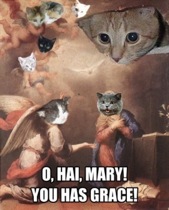
Mary sed “Ceiling Cat is laik a big deal, Mai I is happy about Ceiling Cat… bcz he kepted me in maind an now evribodi knowz i can haz cheezburgr. Thank u Ceiling Cat, u iz cool. U iz niec to evribodi. Xcept peeplz who doant dizrv it LOL. U haz pwned teh r00lrz whiel stil bein niec to teh n00bz. U givd cookies to teh hungri whiel u tolded teh rich “Niec trai.” U wuz niec to Israel an to all Abraham’s famili liek u promist.”
Texting in cuneiform
Nate
:
Held in the hand, a typical cuneiform tablet is about the same weight and shape as an early mobile phone. Hold it as though you were going to text someone and you hold it the way the scribe did; a proverb had it that ‘a good scribe follows the mouth.’ Motions of the stylus made the tiny triangular indentations of cuneiform characters in the clay. The actions would have been much quicker and more precise, but otherwise rather like the pecks you make at a phone keypad.
Some tablets are of course larger. Gilgamesh, thousands of words long, is an epic in 12 tablets more than a foot high, and inscriptions carved in rock are more expansive still. But it is the small tablets with tiny writing that are the most tantalising objects in Babylon, Myth and Reality (at the British Museum until 15 March). Can one, through them, get beyond archaeological evidence and inference, bypass the fevered imagination of William Blake’s and John Martin’s Bible illustrations and hear the voice of a Mesopotamian Pepys?
Well, not exactly, but the range and character of what is written down give some idea of the texture of everyday life in Nebuchadnezzar’s Babylon. The majority of tablets may be the equivalent of office files – letters, legal documents, contracts, mortgages, lists of goods – but there are also messages addressed to the gods, some of them expressing indignance that good behaviour has not been rewarded. Astronomical observations are detailed and medical texts full of diagnostic descriptions. There are records of refurbishments: the kings, who had responsibility not just for religious ceremonies but for the maintenance of temple structures, celebrated their building works.
Nabokov on the translator’s art
Nate
:It was as if someone, having seen a certain oak tree (further called Individual T) growing in a certain land casting its own unique shadow on the green and brown ground, had proceeded to erect in his garden a prodigiously intricate piece of machinery which in itself was as unlike that or any other tree as the translator’s inspiration and language were unlike those of the original author, but which, by means of ingenious combinations of parts, light effects, breeze-engendering engines, would, when completed, cast a show exactly similar to that of Individual T—the same outline, changing in the same manner, with the same double and single spots of sun rippling in the same position, at the same hour of the day.